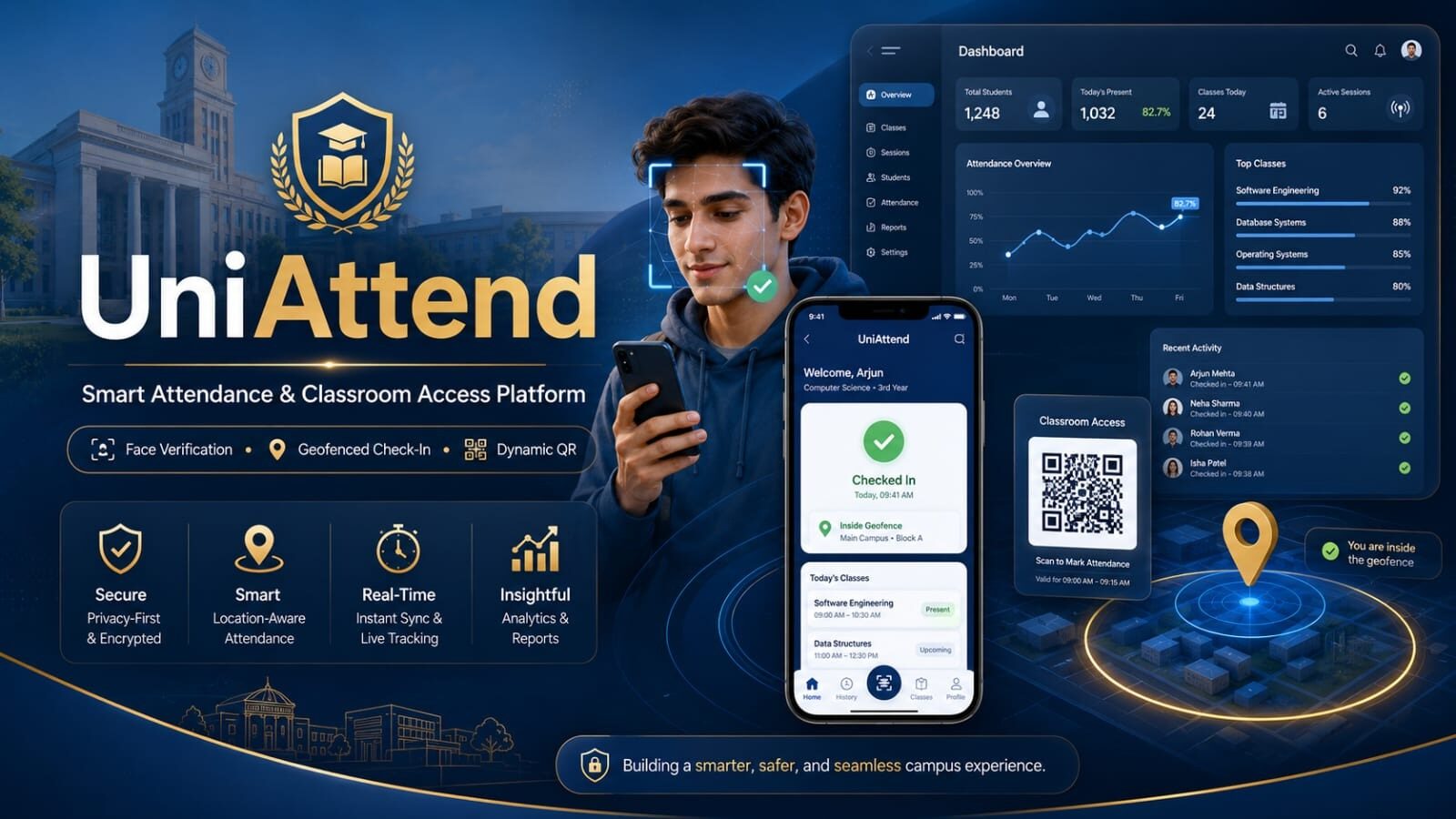
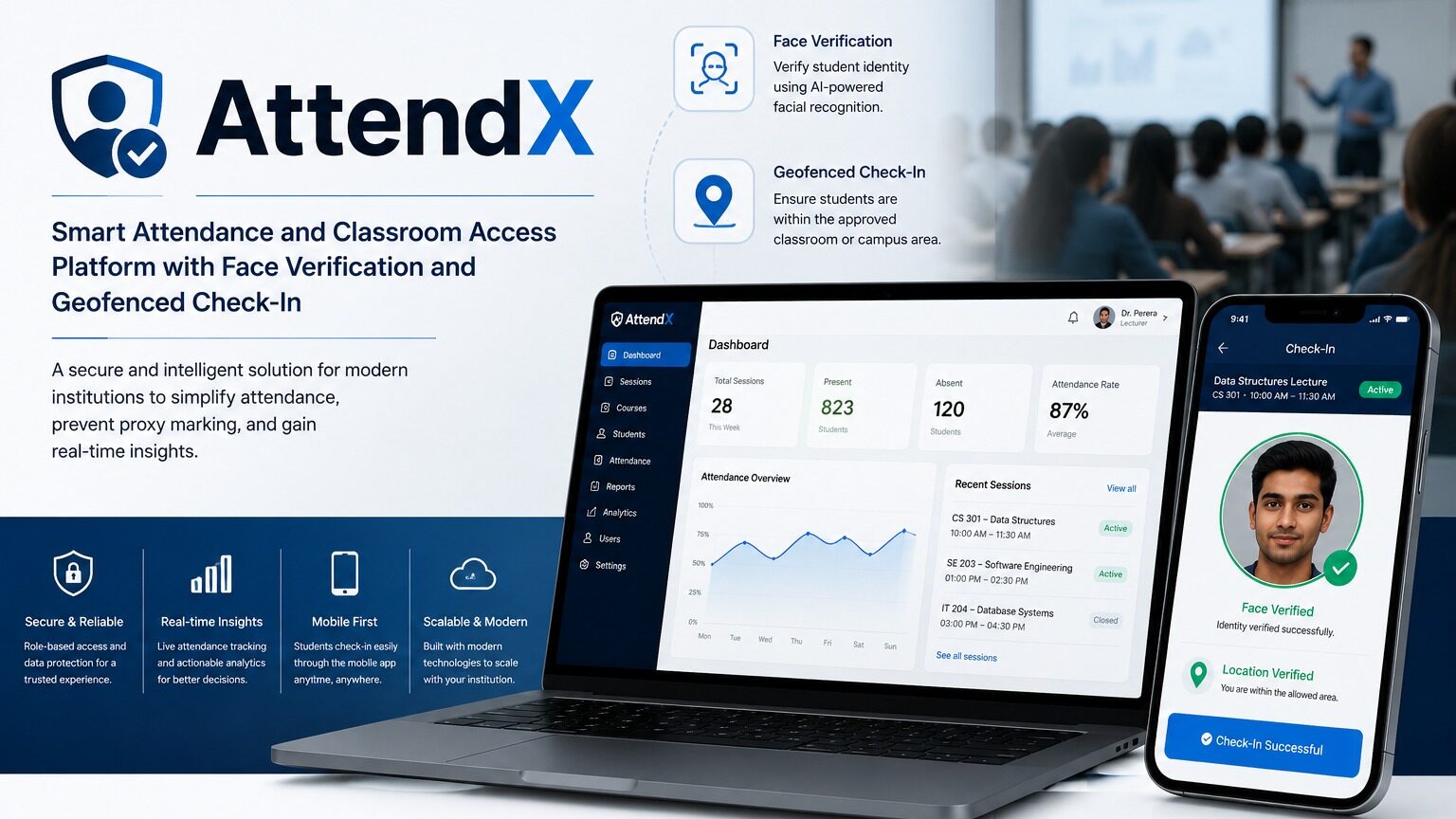
UniAttend is a smart attendance management platform designed for universities, with a student mobile application and web dashboards for lecturers and administrators.
The main goal is to reduce the weaknesses of conventional attendance systems, particularly the time spent on manual attendance, inaccurate record keeping, and proxy attendance. Rather than relying on a single verification method, UniAttend combines identity verification and physical-presence validation as part of the attendance workflow.
Students use the mobile application to view their timetable, attendance history, and active lecture sessions. During attendance check-in, the application obtains the student's location and validates whether the device is within the geofence configured for the lecture location. Face verification is then used to confirm the student's identity against their registered reference data. Dynamically refreshed, short-lived QR codes provide an additional classroom-presence check when required.
Lecturers use the web dashboard to manage attendance sessions, view live attendance information, review verification results, access student attendance data, and generate reports and analytics. When a genuine student cannot complete automated verification because of issues such as location inaccuracies, network problems, device limitations, or face-verification failures, lecturers can handle the case through a controlled manual review process. Important manual changes are recorded to maintain auditability.
Administrators manage the wider academic configuration of the platform, including users, courses, classrooms, geofence locations, academic information, and system-level attendance reporting. Access to system functions is controlled according to student, lecturer, and administrator roles.
The system uses a modular, service-oriented architecture. The student application is developed with React Native and Expo, while the lecturer and administrator dashboard uses Next.js and TypeScript. The main backend is built with FastAPI and handles core functions such as attendance management, course and timetable management, geofence validation, QR validation, reporting, and coordination of the attendance verification workflow.
Face verification is separated from the main backend as an independently deployable service. This service uses InsightFace for face detection, alignment, embedding extraction, and identity verification against a student's registered reference embedding. Separating the face-verification workload allows the computationally intensive component to be deployed and scaled independently without requiring the entire backend to scale with it.
PostgreSQL serves as the primary relational database for persistent and transactional information such as users, courses, timetables, attendance sessions, attendance records, verification results, manual overrides, and audit information. Redis supports short-lived and performance-sensitive workloads such as active-session state, dynamic QR data, caching, rate-limiting counters, and temporary coordination of verification tasks. This separation keeps permanent academic records in PostgreSQL while allowing time-sensitive attendance operations to be handled efficiently during periods of heavy concurrent check-in traffic.
Authentication and authorization are handled through Keycloak using role-based access control. Students authenticate through the mobile application, while lecturers and administrators access the web dashboard according to their assigned roles. Protected APIs ensure that users can access only the functions and information permitted for their role.
The attendance workflow is designed so that different verification mechanisms contribute to a reliable final attendance decision. Geofence validation determines whether the student is within the permitted lecture area, face verification confirms identity, and dynamic QR validation can provide additional evidence of classroom presence. Failed or uncertain verification attempts are handled through controlled retry and lecturer-review paths rather than automatically producing an incorrect attendance record.
The platform also maintains audit information for important actions such as verification outcomes, manual attendance changes, and administrative updates. This improves transparency and allows attendance disputes or unusual verification activity to be reviewed when necessary.
UniAttend is designed to support large university classes and multiple concurrent lecture sessions while keeping the attendance process practical for students and manageable for lecturers. Its modular architecture also allows computationally demanding services such as face verification to scale independently as usage grows.
Overall, UniAttend provides a centralized attendance management system covering the complete process from student check-in and identity verification to live attendance monitoring, attendance history, reporting, analytics, academic configuration, and administrative oversight.