What we set out to build
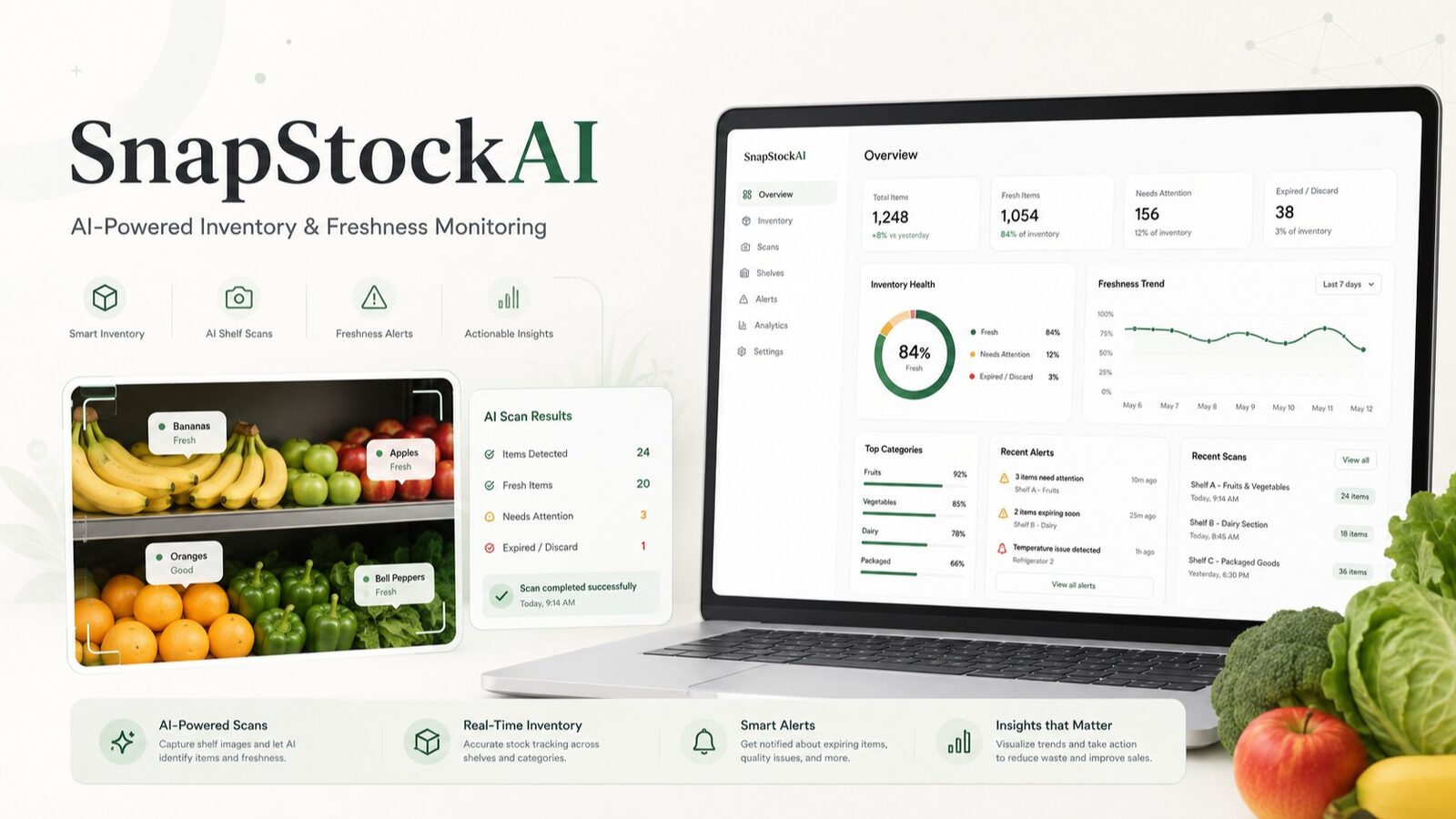
SnapStock-AI targets small-scale retailers who need better visibility into perishable inventory without adopting a full retail ERP. The product vision is a responsive web app where an owner or employee can scan a shelf, see what was detected and how fresh it looks, and eventually manage inventory, alerts, and analytics under a business tenant. The academic delivery window is a working prototype with clear architecture, not a production multi-region SaaS.
Methodology and architecture
We separated the system into three deployable concerns:
Client (client/) — React 19, TypeScript, Vite, Tailwind. Landing pages, auth flows, and a dashboard including a camera/file scan experience. Auth state lives in React Context with JWT stored for protected routes.
API (server/) — Express modular monolith. Feature modules follow routes → controller → service → repository → entity. Auth is end-to-end: registration with bcrypt hashing, email verification and password-reset tokens via Nodemailer/SMTP, login that requires a verified email, and JWT issuance. Detection is a gateway: multer receives the image and axios proxies it to the AI service. TypeORM maps users and token tables; schema changes go through versioned migrations.
AI service (ai-service/) — FastAPI loads YOLO and MobileNet models at startup (with optional Hugging Face download), exposes /detect, /predict, and the combined /analyze pipeline (detect → crop → classify → aggregate). This isolation keeps TensorFlow/Ultralytics out of the Node process and allows AI to restart without taking down login.
Documentation follows an IEEE/RUP-style SRS and Software Architecture Document using Kruchten’s 4+1 views (use-case, logical, process, deployment, implementation), plus design diagrams for scan pipelines, sequences, and deployment.
Challenges and how we handled them
Stack mismatch for ML — Running YOLO and TensorFlow inside Node is awkward. We extracted a FastAPI microservice and kept Express as the trusted boundary (clients never call AI or the database directly).
Model size and cold start — Weights are large. Models load once at FastAPI lifespan (and via cached loaders) rather than per request; first-run download from Hugging Face needs network and optional tokens.
Prototype vs full product — Dashboard pages for inventory, alerts, analytics, and shelves are largely UI-ready with mock or local state; scan history is not fully persisted yet. We document intended multi-tenancy (business_id, OWNER/EMPLOYEE) in migrations and design while focusing implementation on auth + AI scan first.
Security hardening in progress — bcrypt, JWT issuance, verification gates, and email-enumeration-safe messages are in place. JWT middleware exists but is not yet applied to all routes; Helmet/Zod hardening and full RBAC enforcement remain next steps.
Environment friction — AI dependencies need a supported Python (e.g. 3.10–3.12); newer runtimes may lack TensorFlow wheels. Local setup uses Docker for Postgres and separate processes for client, server, and AI.
Results so far
Working auth: register → verify email → login → logout; forgot/reset password with expiring tokens.
Working scan path: camera or upload → Express → /analyze → detections with counts and per-item freshness (good/bad in the current model).
Clear module boundaries and repo layout that match the architecture story evaluators and employers expect.
Design artefacts (SAD, process/deployment diagrams, pattern notes) that explain why the system is shaped the way it is.
Future work
Persist scans and detections; connect shelves and inventory to the database; auto-update stock from accepted scans.
Wire JWT on protected APIs; send Authorization from the client; enforce tenant isolation and roles.
Alerts for low stock and spoilage; real analytics; admin portal.
Move freshness toward the planned Fresh / Medium / Spoiled classes if the model is retrained.
Graceful degradation when AI is down; health checks; tests and production hardening.