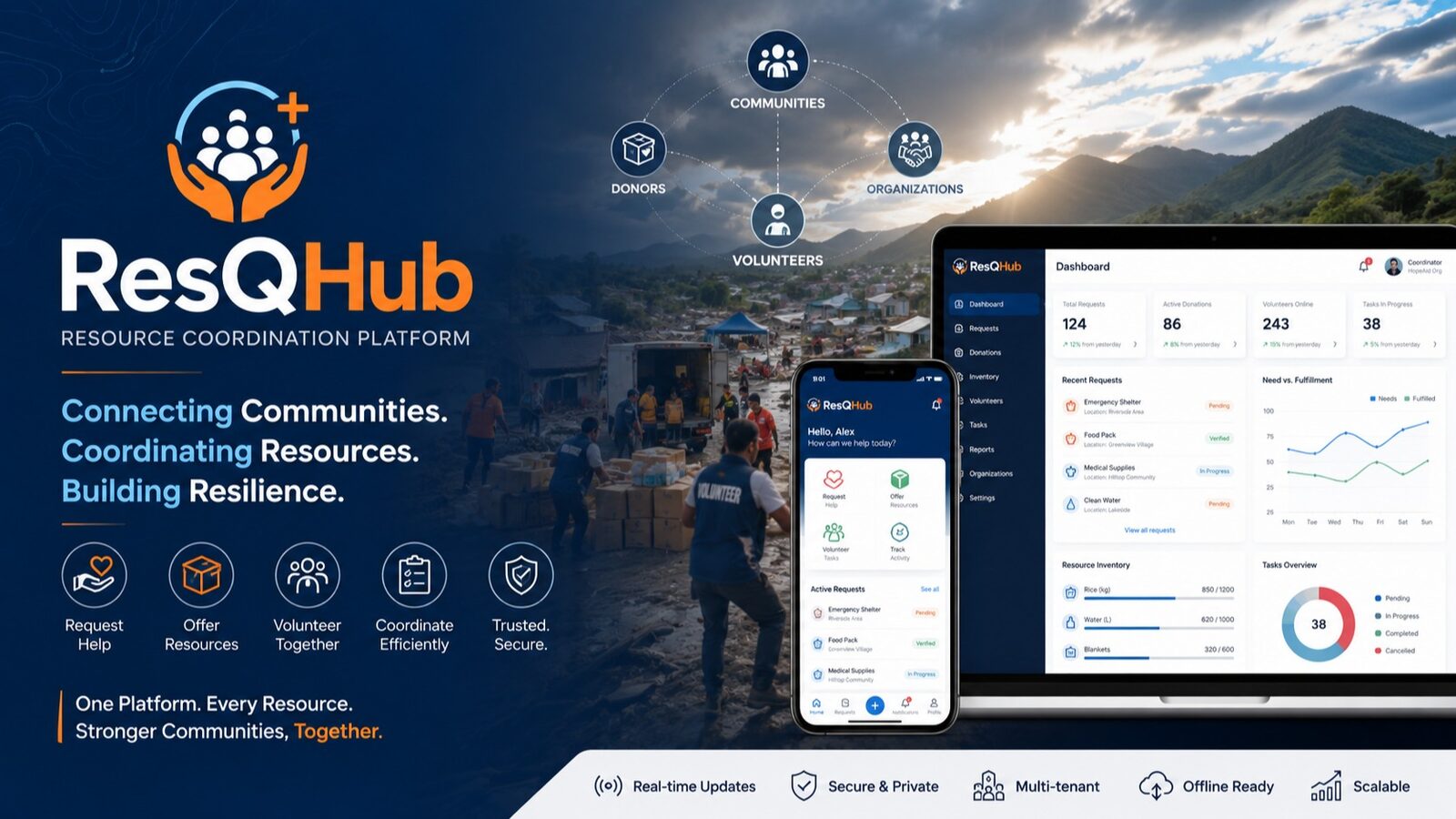
ResQHub was designed around the idea of connecting “haves” with “needs” during localized crises such as floods, landslides or other community level emergencies.
The system has two primary interfaces:
Mobile Application - Community & Volunteer Interface:
Community members can submit help requests.
Users can offer resources as donations.
Users can track the status of their requests and donations.
Registered volunteers can view assigned tasks and update their progress.
The platform supports real-time notifications for relevant activities.
Offline-first capabilities are considered for environments with limited connectivity.
Web Application - Coordinator & Administrator Interface:
Verify and approve community help requests.
Verify and manage resource donations.
Track donated resources through inventory management.
Create and assign volunteer tasks.
Monitor task and request progress.
Provide reporting around need vs fulfilment.
Manage organizations and their operational activities.
Architecture & Methodology
The platform is structured as a full stack, multi-tenant SaaS system using independently deployable backend services. The frontend applications communicate through an API Gateway, which routes requests to the appropriate Node.js + Express microservices.
The main architectural components include:
Frontend → API Gateway → Microservices → Data Access Layer → PostgreSQL
with Kafka supporting asynchronous communication and WebSockets supporting real-time updates. External services are used where appropriate for capabilities such as email, push notifications, maps and file storage.
Security is handled through JWT-based authentication and role based authorization, allowing the system to distinguish between ordinary users, volunteers, coordinators and organization administrators while maintaining organization-level data isolation.
Key Challenges
One of the main challenges was designing the system around different types of users while keeping the experience simple. A community member should not need to understand organizational structures simply to request help or donate resources, while coordinators and administrators require significantly more operational control.
Another challenge was designing the multi-tenant data model, ensuring that multiple organizations can use the same platform while maintaining logical isolation of their operational data.
The system also needs to maintain reliable resource and request states during high demand situations, making database consistency, concurrent operations and real-time state updates important architectural considerations.
Expected Outcome & Future Work
The project aims to deliver a deployment ready prototype capable of supporting simulated high traffic crisis scenarios while maintaining data integrity and reliable coordination.
Future development can focus on improving offline synchronization, expanding real-time capabilities, optimizing the platform for larger numbers of organizations and users and evaluating its performance under increasingly demanding crisis scenarios.
The core goal is simple: replace fragmented crisis coordination with a structured system that makes it easier to identify needs, mobilize resources and get assistance to the people who need it.