Developer tools
Automated Code Review and Technical Debt Tracking Dashboard
Automates Code Review and Tracks Technical Debt From Pull Requests
Abstract
This project is a microservice-based platform that automates code review and technical debt tracking for software development teams. It analyzes code changes submitted through GitHub/GitLab pull requests using static analysis tools, identifies code quality issues, and calculates technical debt using the SQALE methodology. The platform provides role-based dashboards that present technical findings clearly and understandably for developers, administrators, and project managers.
The problem
Traditional code review can be time-consuming and inconsistent, especially when development teams need to review large numbers of pull requests. Developers and project managers may also have difficulty understanding the overall quality of a project and the amount of technical debt accumulated over time. Existing static analysis tools often provide technical findings without presenting them in a centralized and easily understandable form. Non-technical stakeholders, such as business managers or clients, may also struggle to interpret these results, as they are usually presented in complex engineering terms. Therefore, there is a need for a platform that can automate the initial code review process, consolidate analysis results, and provide meaningful technical debt metrics clearly and understandably for both technical and non-technical users.
The solution
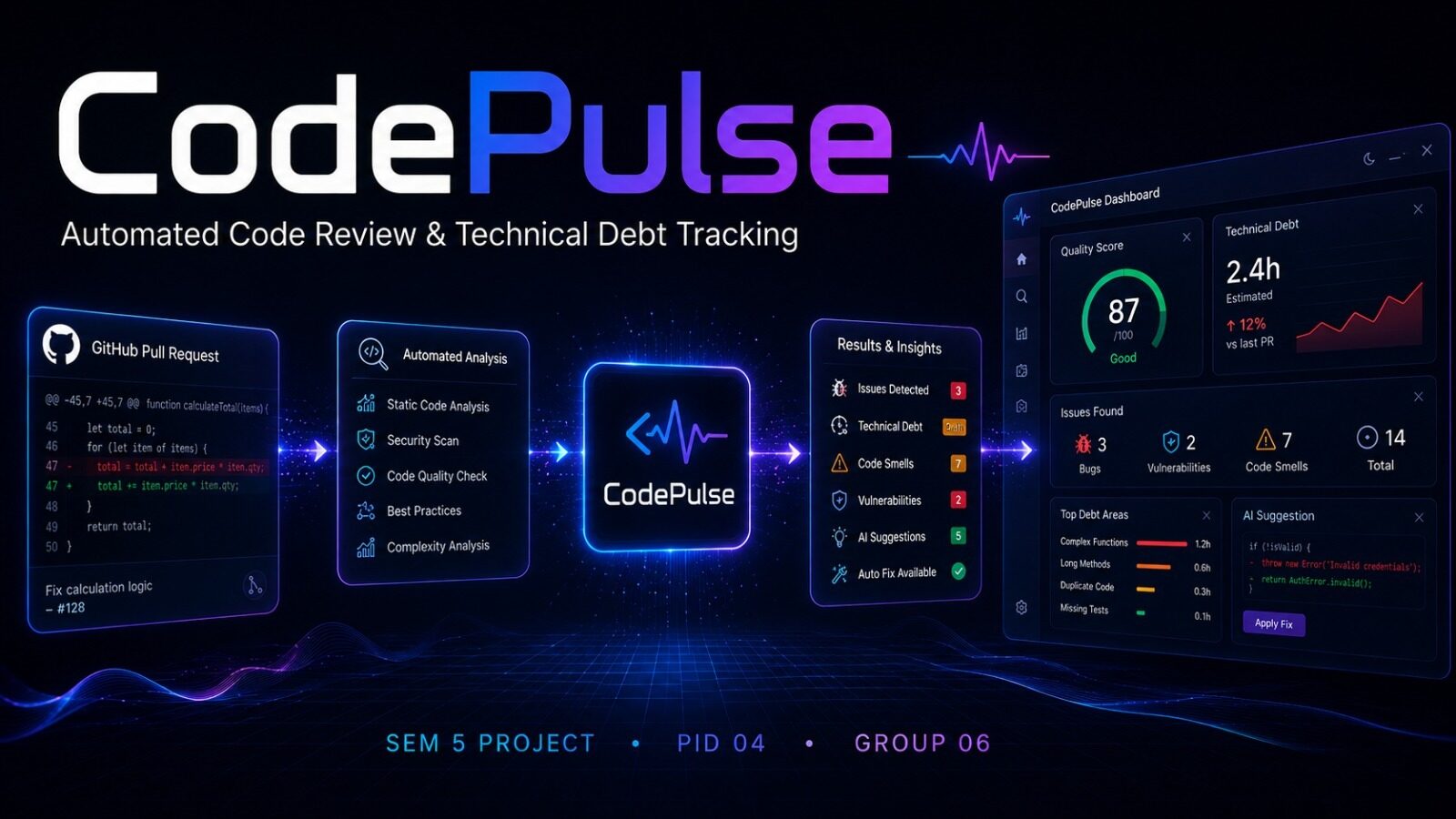
The proposed system provides an automated code review and technical debt tracking platform integrated with GitHub. When a pull request is created or updated, the system receives the repository event, analyzes the changed code using appropriate static analysis tools, collects and processes the results, and calculates technical debt using the SQALE methodology. The results are stored and presented through role-based web dashboards, allowing developers to investigate code quality issues while project managers can monitor overall project quality and technical debt through simplified metrics.
In detail
The Automated Code Review & Technical Debt Tracking Dashboard is a microservice-based software engineering platform designed to improve the efficiency and consistency of code review and software quality monitoring.
The system integrates with GitHub repositories and listens for pull request events through a dedicated webhook service. When a pull request is created or updated, the relevant code changes are passed through an analysis pipeline. The platform uses multiple static analysis tools, including ESLint, Pylint, Radon, and Cppcheck, depending on the programming language being analyzed.
The analysis services identify issues such as coding problems, maintainability concerns, complexity, and other software quality violations. The results from these tools are collected and stored so that they can be viewed and tracked through the platform.
A technical debt calculation component uses the SQALE methodology to estimate the effort required to address identified quality issues. Instead of presenting only raw static-analysis findings, the platform converts these results into technical debt metrics that can be understood and monitored over time.
The platform provides role-based dashboards for different stakeholders. Senior developers can connect repositories, manage projects, submit pull requests for analysis, review static-analysis results, and monitor their contribution to technical debt. Administrators can manage users, projects, repositories, system configurations, and analysis information. Project managers can access simplified project-level quality and technical debt metrics without needing to understand detailed source-code findings.
The system follows a microservice architecture, allowing individual services such as webhook processing, code analysis, result collection, and notification handling to operate independently. RabbitMQ is used for asynchronous communication between services, while PostgreSQL and MongoDB are used for storing structured application data and analysis results respectively.
The web interface is developed using Next.js and provides interactive dashboards for monitoring code quality and technical debt. A Flutter-based mobile application is also used to provide notifications to relevant users when important code-review or analysis events occur.
The overall goal of the platform is to reduce the manual effort involved in initial code review, provide a centralized view of software quality, and help development teams understand and manage technical debt throughout the software development lifecycle.
Screenshots
Related projects